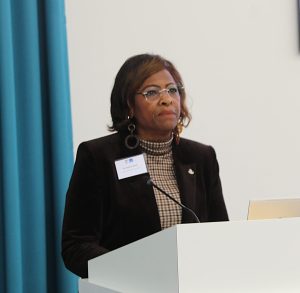
South African-born jurist Navi Pillay wins Nobel Peace Prize for her work in international justice


October 9, 2026 -OSLO, Norway (AP) — Navi Pillay, a South African-born jurist and former U.N. human rights chief whose career has spanned from defending the rights of an imprisoned Nelson Mandela to leading a panel that found that Israel committed genocide in Gaza, won the Nobel Peace Prize on Friday for her efforts to promote international law as it comes under attack.
Her win is sure to be seen as a high-profile rebuke to U.S. President Donald Trump and Israeli Prime Minister Benjamin Netanyahu, who have both rejected the findings of the U.N. commission she led on Gaza. The leaders also have been highly critical of the International Court of Justice and the International Criminal Court; Pillay has worked at both.
Pillay’s work “is a source of hope and inspiration to all those who seek to bring about a more peaceful world,” said Jørgen Watne Frydnes, chair of the Norwegian Nobel Committee, in announcing her win in Oslo, Norway, as part of the peace prize’s 125th anniversary.
The committee said it sought to strengthen international law at a time of conflict, and Watne Frydnes said Pillay’s award was a message to those seeking to undermine “the international rules-based system and the institutions.”
In places such as Israel and in apartheid-era South Africa, she and peers took on some of the world’s most painful and sensitive legal issues and most vulnerable populations.
Pillay, 85, received the news while attending a forum in Nuremberg, Germany, where the trials of Nazi war criminals helped lay the foundations of international law. She was in the same room where the trials were held when prize was announced in Norway.
“Perhaps it was meant to be that I was in this historic Courtroom 600” of the Nuremberg Palace of Justice, she said.
She said efforts to weaken international criminal justice “endanger the progress painstakingly made since Nuremberg, and they risk returning us to a world in which power, rather than law, determines whose suffering matters.”